Table of Contents
Logbook
This is your logbook. Insert here all relevant information regarding the evolution of your project
Weekly Report
1st Week Report: 2016-02-25 / 2016-03-03
In the first week, we were informed by all the possible projects. Our choice was made very easily. With combining all our knowledges, we wanted to do the Water Desalination Project. After the approval of our project, we could do some research and bring all the questions together we could ask for the second meeting.
2nd Week Report: 2016-03-03 / 2016-03-10
We had our first individual meeting with all the supervisors. Maria Cristina Ribeiro and Paulo Ferreira are going to be our main supervisors, which we are very thankful for. Our two supervisors and Maria Benedita Malheiro helped us brainstorming for our project. After the brainstorming we had a good view to obtain our first vision of the project.
By finishing the Gantt Chart, the planning became more clear. After this we are going to think more about the model. The hardest (for the week) was to implement the model in the panels from the dome structure.
Tuesday 16-03-08 the first deadline arrived: Task Identification, Gantt Chart and Task Allocation.
3rd Week Report: 2016-03-10 / 2016-03-17
After the second meeting, it got clear we needed to change the structural draft. Our first idea was innovative, sustainable and a good theoretical model but very complex. It would be hard to build the model itself and not realistic to put it into one panel of the dome structure.
By doing some research we found an 'easy' idea to desalinate the sea water. With this idea we made a experimental model by the helping hand of Abel Duarte. He helped us finding the materials: a glass goblet, a plastic board and a shot glass.
The first experimented did not end as we wished. It did not work like we wanted it. This week and next week we will do some other tests with other glass shapes and dark coloured containers.
4th Week Report: 2016-03-17 / 2016-03-31
The day after Easter we had a meeting. We made the leaflet (for deadline 2016-04-01) and the cardboard model (for deadline 2016-03-29). Next step will be:
- Making a scale model and do some experiments
- Choose the materials.
We did also the distribution of the report parts. Every topic will be done by two people to have a objective approach.
5th Week Report: 2016-03-31 / 2016-04-07
Experiments Testings were done on the roof. We had some positive results! When the weather conditions will be better, the experiment can restart again with some adjustments like:
- close the pyramide
- use other container
- use several colours of container
- think about how we can collect the purified water
Report Everybody is writing on their piece of the report
6th week Report (2016-04-07 / 2016-04-14)
Everybody is upgrading the wiki page.
7th week Report (2016-04-14 / 2016-04-21)
Everybody is preparing to make an optimal presentation for thursday.
8th week Report (2016-04-21 / 2016-04-28)
After the Interim presentation and receiving the comments, the team was able to improve the report. For this, every member needs to work on a piece of the report. The task distribution:
- Ethics= Marion
- Project Development = Marion and Lies
- Project Development = Marion and Lies
- Introduction = Maciej
- State of the Art = Maciej
- Sustainability = Pol
- Marketing = Minji)
- Organisation: (ref., picutres, table, bibliography,…) = Pol
- Electronical Schematic= Pol and Marion
- Tests/Brico Depot= Maciej and Lies
- Conclusion= Min Ji
After this we will all work on the editable Report to make a scientific interim report
9th week Report (2016-04-28 / 2016-05-12)
This week we will have a meeting with Cristina to calculate the Thermodynamics. This we can add in the wiki. Furthermore we will do the tests when the weather is better (next week), the results will be put into the wiki.
10th week Report (2016-05-12 / 2016-05-19)
We have been thinking about cleaning the salt water containers without opening the pyramid. Cleaning it with some detergents would be easier than opening it with hands. This week we could not make any tests because of the wheather. We are still working on the report and geting some footage for the final video.
11th week Report (2016-05-19 / 2016-05-26)
This week after hearing we cannot 3D print base of our module we started to build it by ourselves with materials that has been bought or were given to us. We visited the workshop to cut the cardboard and we painted it outside of the building. In the end we have glued every part and now the module is waiting to be tested.
12th week Report (2016-05-26 / 2016-06-02)
Meetings
1st Meeting (2016-02-25)
Agenda:
- Presentation
- Modus operandi
- Project proposals
- Electronic Logbook
Minute:
During this meeting, Benedita explained all the projects briefly. We discussed the next day which project we could choose. Related to our studies, our first choice was Water Desalination. We got the project!
2nd Meeting (2016-03-03)
Agenda:
1. General
- We are going to use solar panels to automatically getting a signal when their is to much salt for the desalination process, when ocean water needs to be refilled and when the box of desalinate water is almost full
- We are going to make a model by buying materials with our 150 euro sponsoring from ISEP
- For preview, the dome will be constructed at ISEP. The market actually, would be near by the ocean or at the ocean
- We aim for a continuous process
2. Model
- Dimensions
- Sustainability: we aim for the use of renewable energy and sustainable materials
- Source for energy: all green energy
- We are able to use the Software we used at our schools: Solidworks, AutoCad, Arduino and Labview
3. Marketing
- A survey will help use to get who would like to use our product
4. Working process
- We will not use chemical products
- The laboratory from school are free to use
- We will not need to control the quality of the water
- Ocean water will be used
Minute:
We would like to talk in general about the project. Discuss further actions we can do. Search some information about (solar) desalination. We need to search which options are available.
3rd Meeting (2016-03-10)
Agenda:
Figure [insert figure cross-reference] …
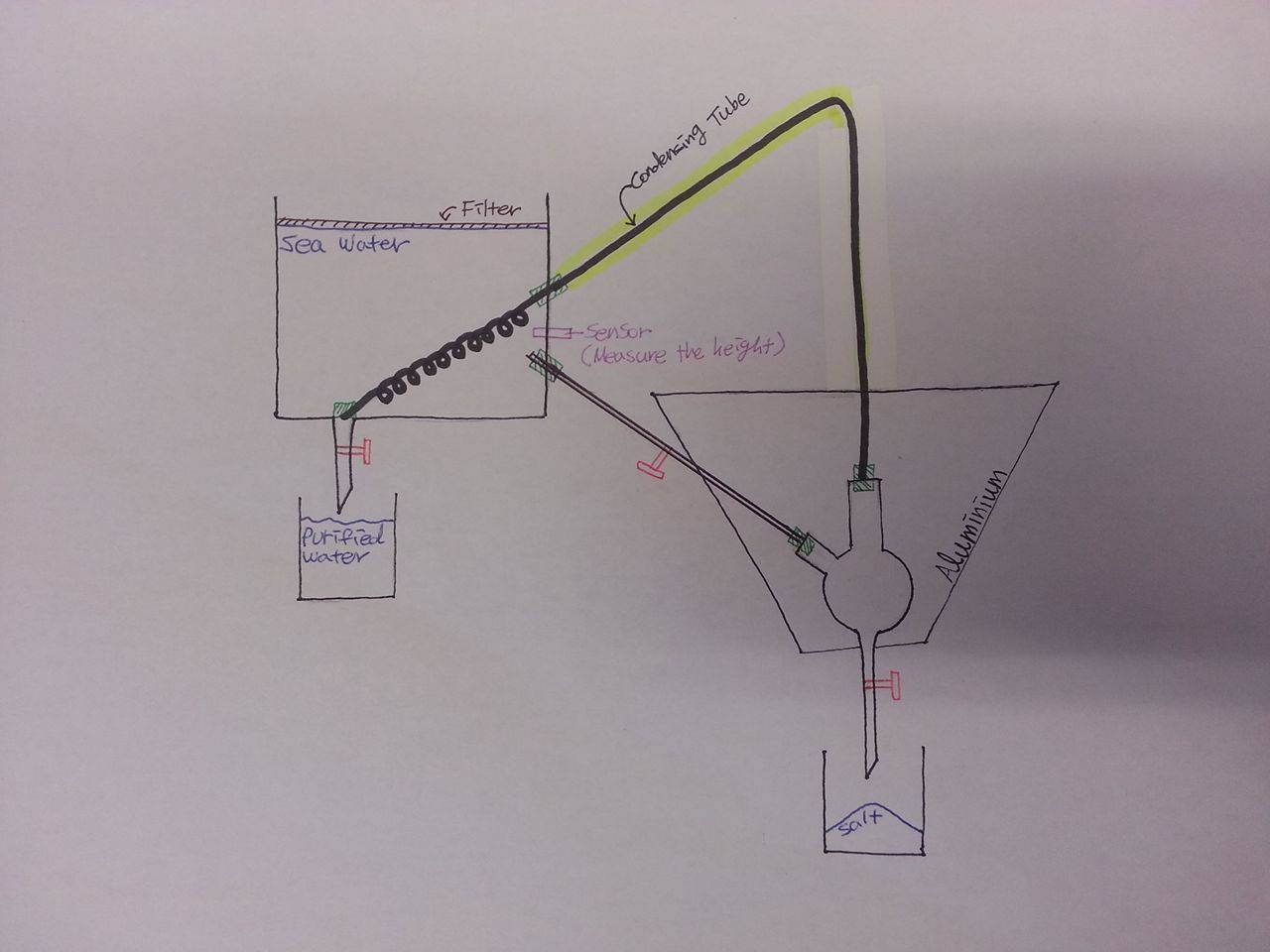
[Please insert an automatic Figure caption]
1. Model: We were brainstroming about the structure of the interactive system. We already have a model, now we have to do more research about the process and how we are going to implement our model in the panels from the dome structure.
Explanation of the working process:
- Elements:
- Big container for the salt water:
- The idea is to let the users pour the sea water in the container.
- There will be a filter above the container, to avoid the entrance of undesirable dirt
- We need to measure the temperature inside the container to be sure the difference of temperature between container and condensing tube is high enough
- One sensor will be used just above the tube to alarm when the container must be filled with sea water
- Inside the container three holes must be made. One on the bottom and one on the side, to let the condensing tube cross the container. The third hole will be used to lead the water in the balloon
- Reaction Balloon:
- We find a 3-neck round bottom flask with outlet for making the reaction. But buying a new one will be to expensive so we have to find a used one. If it's not possible, we can create a balloon with a cap at the bottom.
- Solar Oven: Cone shape, cover with aluminium, with the balloon in the centre.
- Two collectors, one for the clean water and one for the salt.
- A tube, composed by two parts; one should keep the heat and one should help to cool and condense the steam.
- Operations:
- The user put salt water in the big container.
- The water flow trough the tube to the balloon.
- Solar energy gathered in the solar oven heats the balloon and water inside. Rock or biomass presence can increase this effect.
- Distillation process start : the steam rises through the condensing tube.
- The condensing tube cross the big container of sea water and condense the steam into liquid.
- The purified water is collected in a container.
- When the amount of salt is big enough, we collect the salt using the outlet in the bottom of the balloon, into a container.
- Materials:
- Big container we are going to use Perspex. It is cheap (for 0.50 m x 0.50 m x 0.02 m = appr. 20 €)
- 3-Neck with Bottom Outlet Round Bottom Flask will be made out of glass (appr. 120 €)
- The solar oven exist mostly out of aluminium, we will be informed by Armando Ferreira
- For the other containers we are going to use recycled materials
2. Goal: Create distilled water from seawater.
3. Marketing:
- Governmental institutions: cities close by the ocean
- Associations: red cross
- Private customers: camping, people who live on water, eco-lovers, surfers who live near the beach
4. Management: Finishing task identification, task allocation and the Gantt Chart
5. Sustainability To make our project sustainable, we have to find green energy. So we will use sun power increased by the aluminium oven. We also thought about other sustainable solutions to bring heat, rocks (xisto/schist rock from the North of Portugal) or biomass. We have the contact of Fernando Ferreira, who works on solar ovens; so maybe he can give us informations and materials about his work.
Minute:
4th Meeting (2016-03-17)
Agenda:
Figure [add a cross reference to the figure] …
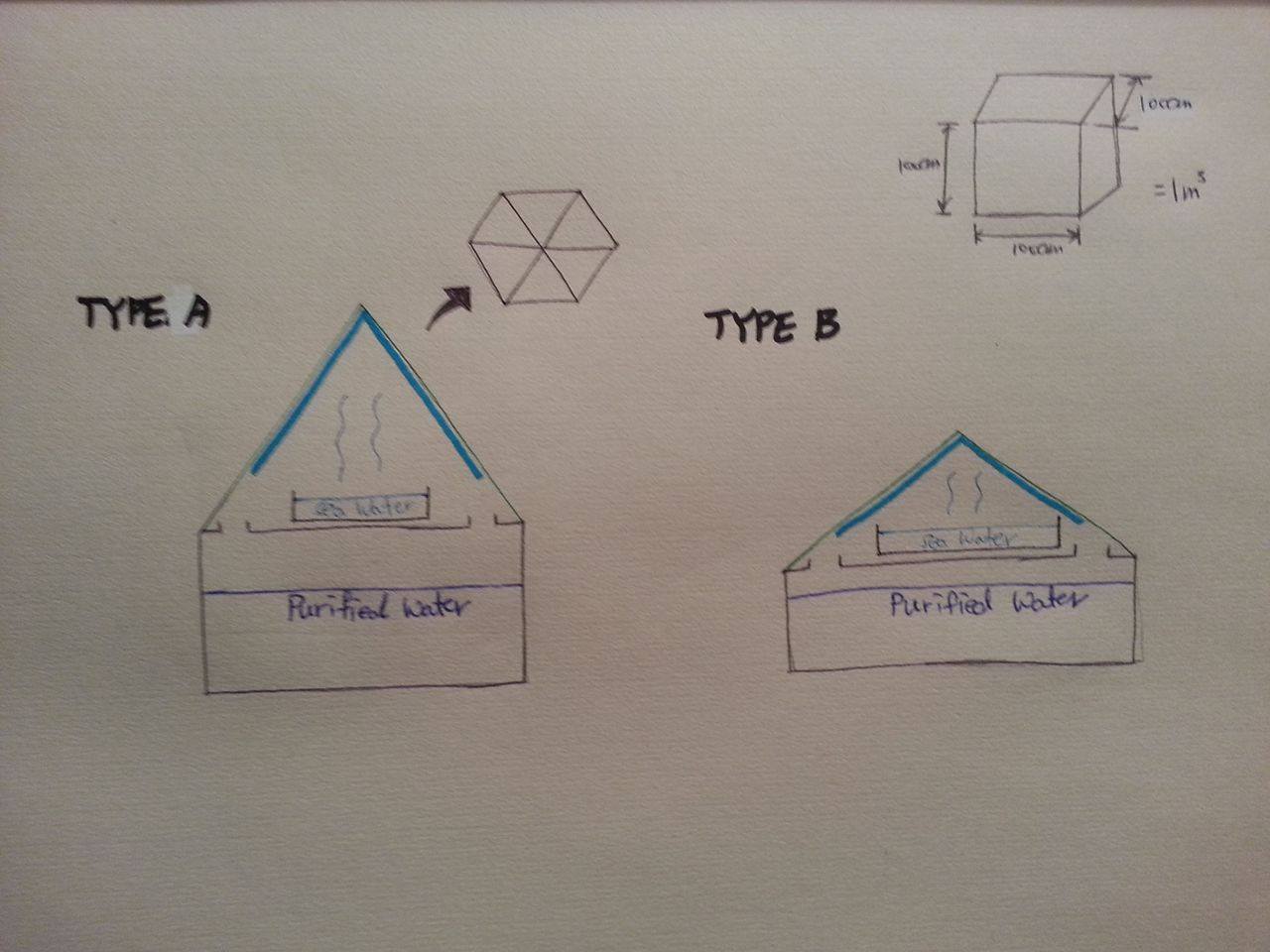
[Please insert an automatic Figure caption]
1. Model:
A new model is constructed, by doing researches we have got a few models. Now the experimentation can begin…
Elements: A dark small and large container and a bowl or pyramid made out of glass.
Explanation of the working process: We are going to test the working principle with four types. A small black container on the big container filled with sea water. The two types are different in the shape of the glass. One will be a bulb shape, the other one will be a pyramid shape. We also will examine if the height of the glass will influence the velocity of the process.
With this model, we will be able to put construction on the panel from the dome. To pump the sea water to the panel we want to use an aquarium pump. We are still thinking about how we will pour the purified water out of the container down to the base floor.
2. Goal: Create distilled water from seawater. The whole process must be fitted into the panel of the dome.
3. Marketing: During marketing class we have an idea what we will have to do to make the marketing plan: Cost, Integrated Marketing Communications , Packaging, Brand Strategy, Services
4. Management: We will be able to update the Gantt Chart after the management Class.
5. Sustainability: We want to use Xisto to make the containers. Roque Brandão wants to bring a piece of Xisto to make the container next week.
Minute:
5th Meeting (2016-03-31)
Agenda:
1. About the model
Their were 4 proposals of building the model, those are made in Sketch Up and the drawings can be find in the report.
We are going to use the experiment with the salt water in the middle and the pyramidal shape glass.
For this we have some arguments:
- It is easier to have one container of salt (water) to refresh.
- The pyramidal shape will be easier to built. the 5 glass triangle pieces will be attached with each other by some junctions (we have to think about what the junction will be)
- It will be safer to use the pyramidal shape of glass. The junction parts will hold the glass together.
- One triangle glass can be opened to have fresh air and stop the process. After we can collect the salt from the salt container and to add new saltwater.
2. Distribution of the tasks
- the Introduction:including the tasks, team members allocation and Gantt chart: lies + Min Ji
- State of the Art: Maciek + Pol
- Marketing Plan: Maciek + Min Ji
- Project Management: Marion+ Lies
- Eco-efficiency Measures for Sustainability: Pol +Lies
- Ethical and Deontological Concerns: Marion + Pol
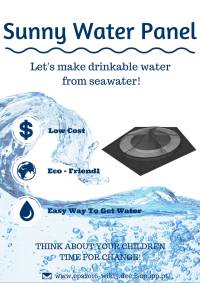
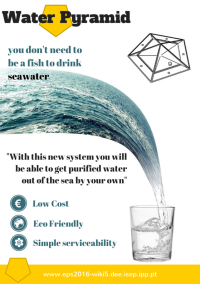
3. Leaflet We did a first approach for the leaflet. All the needed information is in the leaflet. Now we are searching an idea to improve the design, find something to attract. In Figure 1 are some try outs.

4. Questions for project management
- User manual needed
- Have a resume of the project in the beginning of each part
Minute:
6th Meeting (2016-04-7)
Agenda:
1. Model
- 2016-04-06 we had a meeting with Cristina Ribeiro about the materials we are going to use :
Perspex for the pyramid PVC for the 2 big containers stone container for the salt water
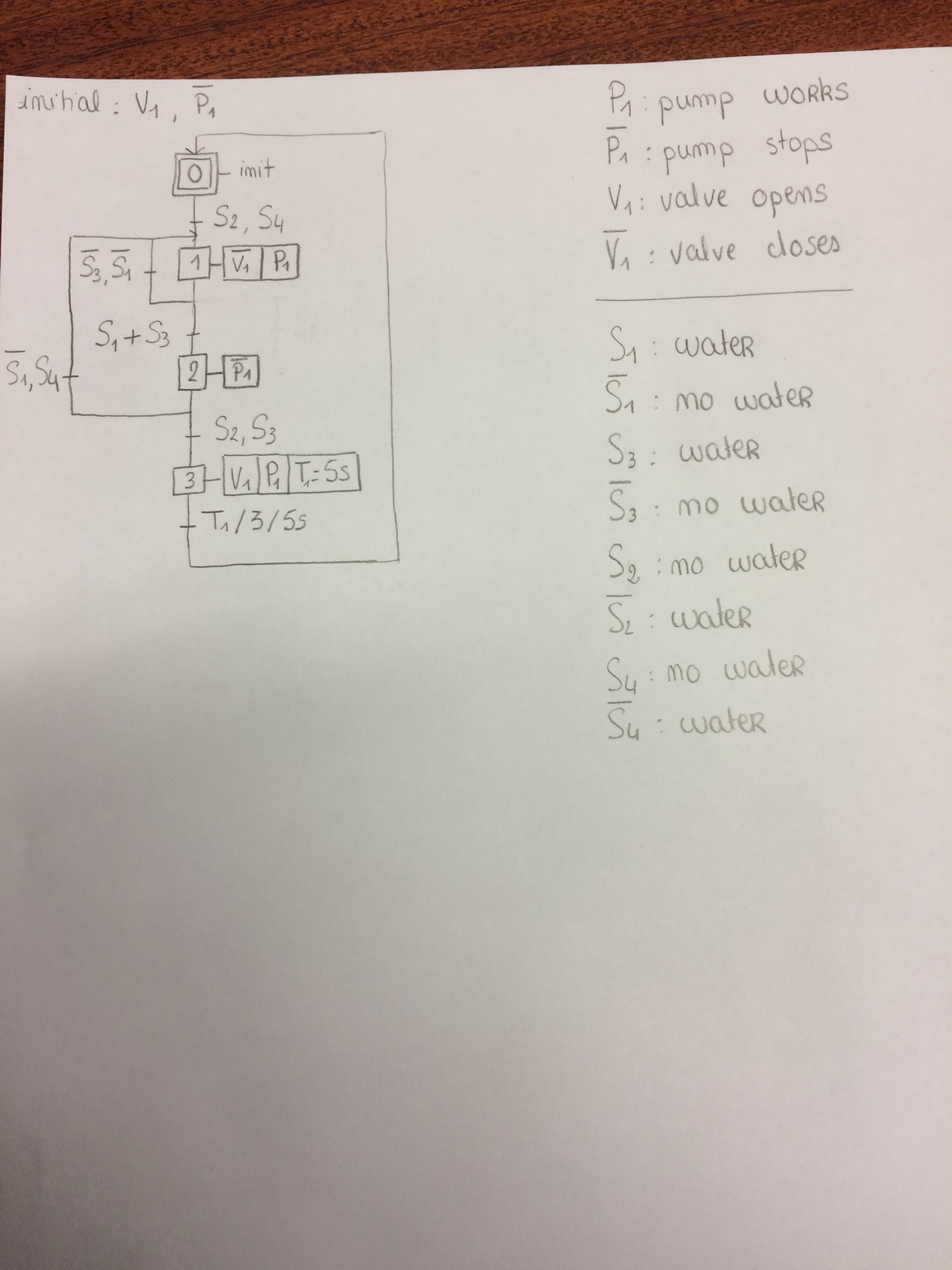
- Schematics are finished, they are seen in Figure 2
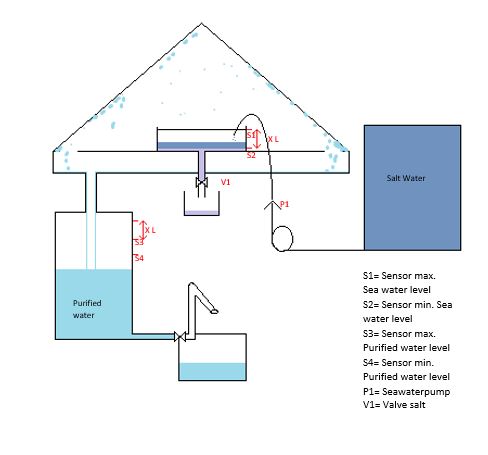
2. Report
- We are working on the report. Everybody will finish his task at 16-04-12
3. Questions
- Can we use grafcet language to program the Arduino ?
- Can we have a meeting with Paulo Ferreira for the Arduino ?
4. Experiment Think about measuring the condition : temperature, quantity of water Can we use a thermometer ?
5. Next week :
- Make all the calculations, size, amount of materials, percentage of condensate water, energy needed
- Found the suppliers
7th Meeting (2016-04-14)
1. Report
Everyone is writing on their piece of the report. This will be done after today. So we can all read other pieces to approve and delete mistakes.
- how to put references in the wiki page
- How to refer to pictures?
like this?
2. Experiment
The weather conditions do not let us make more experiments on the roof. Next time when experiments will be made we need to think about:
- closing the pyramid
- using different kind of coloured (pvc and stone) salt containers (coaster for flower pot)
- how to collect the purified water
3. Material
- Is it possible to use some materials from ISEP:a coaster of a flower pot for the salt water, tap, hose pipe, container for the purified water
8th Meeting (2016-04-28)
After the Interim presentation and receiving the comments, the team was able to improve the report. For this, every member needs to work on a piece of the report. The task distribution:
- Ethics= Marion
- Project Development = Marion and Lies
- Project Development = Marion and Lies
- Introduction = Maciej
- State of the Art = Maciej
- Sustainability = Pol
- Marketing = Min Ji
- Organisation: (ref., picutres, table, bibliography,…) = Pol
- Electronical Schematic= Pol and Marion
- Tests/Brico Depot= Maciej and Lies
- Conclusion= Min Ji
After this we will all work on the editable Report to make a scientific interim report
9th Meeting (2016-05-12)
A new idea to clean the system occured. After a couple of weeks of using the system we would like to pump some cleaning agents to decomtaminate the pyramid from dirt, micro-organisms and salt ingredients. This might be easier than opening the pyramid by hand.
- After uploading the interim report we took holidays. Now we got some equipments to make the project, we have to go to the shop to buy the glue and perspex.
- Next week the weather will be better to make the experiments.
- To make calculations of thermodynamics we would like to make a meeting with Cristina.
Next things which has to be done are:
- Upgrading the Interim Report
- Doing the testings
- Making a poster
- Making pictures/videos of our work to make an optimal video at the end.
- Thinking about what to put in the Manual and how to make it.
10th Meeting (2016-05-19)
We heard that it is possible to use 3D printer at ISEP. Since inside of the module has some uncommon shapes we think it is easier to build it this way, but we have some questions according to 3D printing:
- what material is used to printing?
- will this material be good for our project?
- how long will it take to print it?
- If the material is not good enough for our project. Is it possible to make a real small scale model out of 3D printing to show everyone? (A sketch up model is already made)
Besides 3D printing we brainstormed an idea about trying to use bigger space to heat up the inside of module by using mirrors on sides. Is this idea makes sense and will it affect our module in a good way?
11th Meeting (2016-05-26)
For this moment, we are working on the prototype.
12th Meeting (2016-06-02)
- We have some questions for the electronical part.
- When must the scientific paper be delivered?
13th Meeting (2016-06-09)
Last meeting before the final presentation
- Factura : 17.97 € in leroy merlin. With NIF number and name of the school
- Prototype :
After some tests, we figured an issue in our prototype. The dark container for the brain began to deform itself…


So we had to change the salt container. We found (thanks to Abel) a new one.
- Thermodynamics :
- Thermodynamic scheme :

- Thermograph: During 2h we mesured different temperatures on the system and also humidity.The beggining of the experiment is with the pyramid on the sun, after in the shaddow.


With the new dark container :


- Questions
- Price : We will sell two products. One of the size of the protoytpe and one adapted to the dome. But this last one is very big and very expensive, so it's why we want to sell also a little and cheaper one.
- Big one : Total cost of matrerial : 226.34€ + People + Time + Transport + Advertising + Packaging → selling price : ????
- Little one : Total cost of material : 81.75€ + People + Time + Transport + Advertising + Packaging → selling price : ????